
To Hell With Moral Realism
Rights, Duties, and Other Fairy Tales

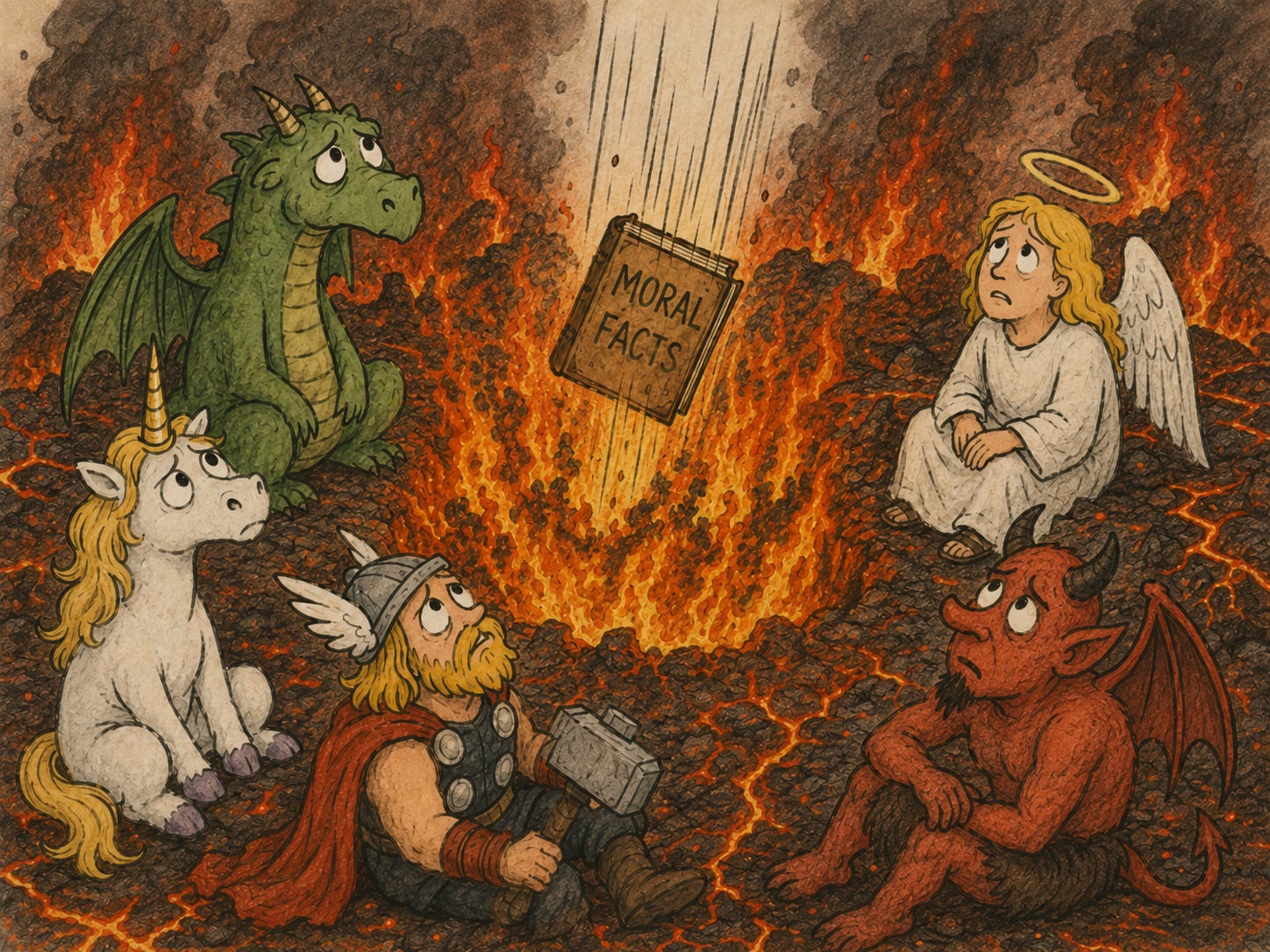
I haven’t written a blog post in a while. My apologies, I’ve been quite busy working on a book. But since several of you have taken out paid subscriptions to support the newsletter, I feel compelled to remedy the lack of a new post now. Not because I think there is a moral fact, a duty, or anything of the sort, but simply because I subjectively value the support of my readers.
Accordingly, the topic today is moral realism: the view that there are moral facts, that there are objective moral properties out there in the world.
There are not.
Notions like ‘rights’, ‘wrongs’, and ‘duties’ are leftovers from a pre-scientific age in which dogma and myths ruled over evidence and reason. And much like unicorns, gods, and other fairy tales, they should be consigned to hell.
Despite the pride we take from human scientific and technological advancements, our minds, our brains are as much obstacles to these achievements as they are its cause. Humans are largely irrational and addicted to their own intuitions, which we had to overcome in order to develop modern science.
Of course, even when it comes to science, we have hardly overcome this psychology. The rise of anti-scientific sentiments is not a reflection of the realization of flaws of science, as some conspiracy theorists may proudly proclaim, but simply a reflection of our poorly designed primate brains (from the perspective of finding out truths about the world).
But when it comes to morals, our thinking has barely changed from our ancestors. The dogma of moral realism firmly remains part of much of our modern culture. This is emphasised perhaps nowhere more strongly than in today’s culture wars, which have turned differences in subjective values into the death of reason itself. For we now know quite well that participation in political causes tends to diminish your capacities as a reasoner. Much like rooting for a particular team in sports can turn one into an irrational hooligan.
The great Harvard psychologist Joshua David Greene wrote a PhD thesis, not in psychology, but in philosophy. Under the supervision of David Lewis and Gilbert Harman, he wrote a thesis with the wonderful title The Terrible, Horrible, No Good, Very Bad Truth About Morality and What to Do About It, arguing that:
the enemy, the wolf in sheep’s clothing, is moral realism. Conflicts of interest may be inevitable, but they need not be exacerbated by people’s unflagging confidence that they’re right and that their opponents are wrong.
But why do philosophers cling to moral realism? The answer is simple.
Philosophers, much like the common science denier, love their intuitions. Where science conflicts with common sense it is science that looks suspect. So much so that philosophers have historically continuously embarrassed themselves by defending prejudices, myths, and a great many blunders that we now look upon in shame — and make the hostility of many scientists against philosophy hardly unjustified.
Whereas scientists teach their students that intuitions are unreliable garbage when it comes to understanding the world, many philosophers venerate their intuitions. Those that don’t are naturalists, as I’ve argued in my most popular blog posts here:


And no intuition is stronger in people than the strong conviction that their own deeply held values are the objectively right ones. They are not just a reflection of one’s idiosyncratic set of subjective likes and dislikes, but they are projected upon the world, with the kind of zealotry glee that turns some people into defenders of the poor and others into mass murderers.
But how would we even live in a world that ‘abandons’ morality? Greene and I hold the same view:
The solution […] is to get rid of realist thinking and to start by getting rid of realist language. Speak only in terms that make the subjective nature of value plain.
Some philosophers try to trap you in a kind of gotcha! Hah! You can’t hold values unless you’re a moral realist. But that view is obviously ridiculous. My subjective evaluation of chocolate ice cream over vanilla requires no metaphysical hocus pocus. Nor does my high regard for other animals.
Instead of saying that capital punishment is wrong say that you are opposed to it. Say that it is an ineffective deterrent, difficult to implement in a colorblind fashion, and likely to lead to irreversible mistakes. And then say no more. Instead of saying that eating animals is wrong and a form of murder, say that you are opposed to eating animals because you wish to alleviate suffering and you believe that this practice causes much unnecessary suffering.
It is, of course, strategically tempting to use the archaic language of moral realism to realize one’s preferred vision of the world. If you can convince people that factory farms are objectively wrong, it stands to reason that they’ll have no choice but to become vegans.
Alas, how successful is this approach really?
People hate being moralized at. Not just about veganism. People hate being told that their behaviour, whatever it is, is immoral. Yet, the same people love a good scolding, if they can dish it out to others, who do not act in alignment with their preferred values.
It’s only the belief that we are on the right side of history, that the other side is blinded, and only has to be shown the light, that it seems like such a promising strategy.
Just like the religious zealots standing in town squares with annoying loud speakers in the firm conviction that they’ll be able to pull the wool off your eyes to make you see.
This is why I’ve argued that effective altruists promoting animal welfare, and everyone else for that matter, would be better served becoming a moral nihilist to realize their vision of the world:

And yet, I have little hope that moral realism will land in the dustbin of history. Our minds are just too hard-wired for dogmatism. If people don’t believe scientific results if they don’t align with their intuitions about reality or if they conflict with their values, what hope is there that our species can overcome the plight of moral realism?
*Edit: Due to popular demand, I’ve written up a follow up post here, arguing that we no longer need moral philosophy:
The End of Moral Philosophy

In this essay, I’ll try to briefly explain why I believe that the most despised theories in ethics and meta-ethics, respectively, can resolve all of ethics when combined.
If you enjoyed reading this post please like, share, and subscribe. It helps a lot to reach a wider audience. I am also interested to read your thoughts in the comments, regardless of whether you agree or disagree. I try to respond to all.
What is this argumentation:
"But why do philosophers cling to moral realism? The answer is simple.
Philosophers, much like the common science denier, love their intuitions. Where science conflicts with common sense it is science that looks suspect. So much so that philosophers have historically continuously embarrassed themselves by defending prejudices, myths, and a great many blunders that we now look upon in shame - and make the hostility of many scientists against philosophy hardly unjustified."
If I wrote this as an undergraduate I would have been rinsed. Explaining why those who disagree with you "cling" to their beliefs which you have offered no actual argument against is very poor form. Lumping realists in with past philosophers who have been wrong about stuff is just so cheap it is nuts. A realist could write the exact same non-arguement against you. They'd just have to frame you as clinging to an apparently clearly irrational belief due to other considerations.
I’m a bit torn on this one. As a fellow anti-realist I actually share a lot of the sentiments expressed here. I think it comes down to what you were trying to do. If the purpose of this was mainly expressive, then that’s your prerogative. But given a couple of your critiques I feel like it’s presenting argument as well. You say “people don’t like being moralized to”, which I think is true. But they also don’t like being sneered at and condescended to, and this reads very condescending. Once again, not trying to tone police, just saying if this is supposed to be compelling to people, the way it’s presented is possibly at odds with that. I constantly criticize apologists and people like Michael Huemer for being sort of flippantly dismissive and only making arguments that are compelling to people who already agree with them, and unfortunately I feel the same about this. The best this can do is let other anti-realists like me be like “Yeah, get em Walter!”, but likely any realist who reads it will just take it as immediately condescending and leave. It’s mainly just signaling, which I don’t think is “wrong”, just not sure if that’s what you were actually trying to do.