
Is Diversity Intrinsically Valuable?
On the merits of thought experiments in philosophy and a reply to Eric Schwitzgebel

Recently, I have written a series of blog posts highly critical of the methods of analytic philosophy and its odd flurry of wild speculation untethered to what goes on in the science and combined with appeals to intuion and common sense:


But with the exception of panpsychism, I haven’t really discussed any examples in depth to demonstrate how the methods of traditional analytic philosophy are flawed and ought to be abandoned in favour of naturalistic philosophy.
Enter Eric Schwitzgebel, one of the most-well known bloggers in philosophy, who has written many wonderful essays that I’ve thoroughly enjoyed. Yet, in his latest blog post he tries to argue that diversity is intrinsically valuable. Not instrumentally for some other end. But in itself. Immediately, this raises the question of how we can determine whether anything is intrinsically valuable. One might expect philosophers, the experts on such matters, to have come up with some ingenius methods for doing so. Unfortunately not.
Schwitzgebel writes:
How does one argumentatively establish the intrinsic value of diversity? The only way I know is to reveal, through thought experiment, that you already implicitly accept it -- and then to ward off objections.
Really? Naturalistic philosophers have long been critical of the excessive reliance by philosophers on thought experiments. Whereas we discard scientific experiments when they are biased to favour a particular conclusion, philosophical thought experiments can often be pernicious (not always) in that they are designed to favour a particular conclusion, without that being obvious from the outset. So let’s look at Schwitzgebel’s thought experiment:
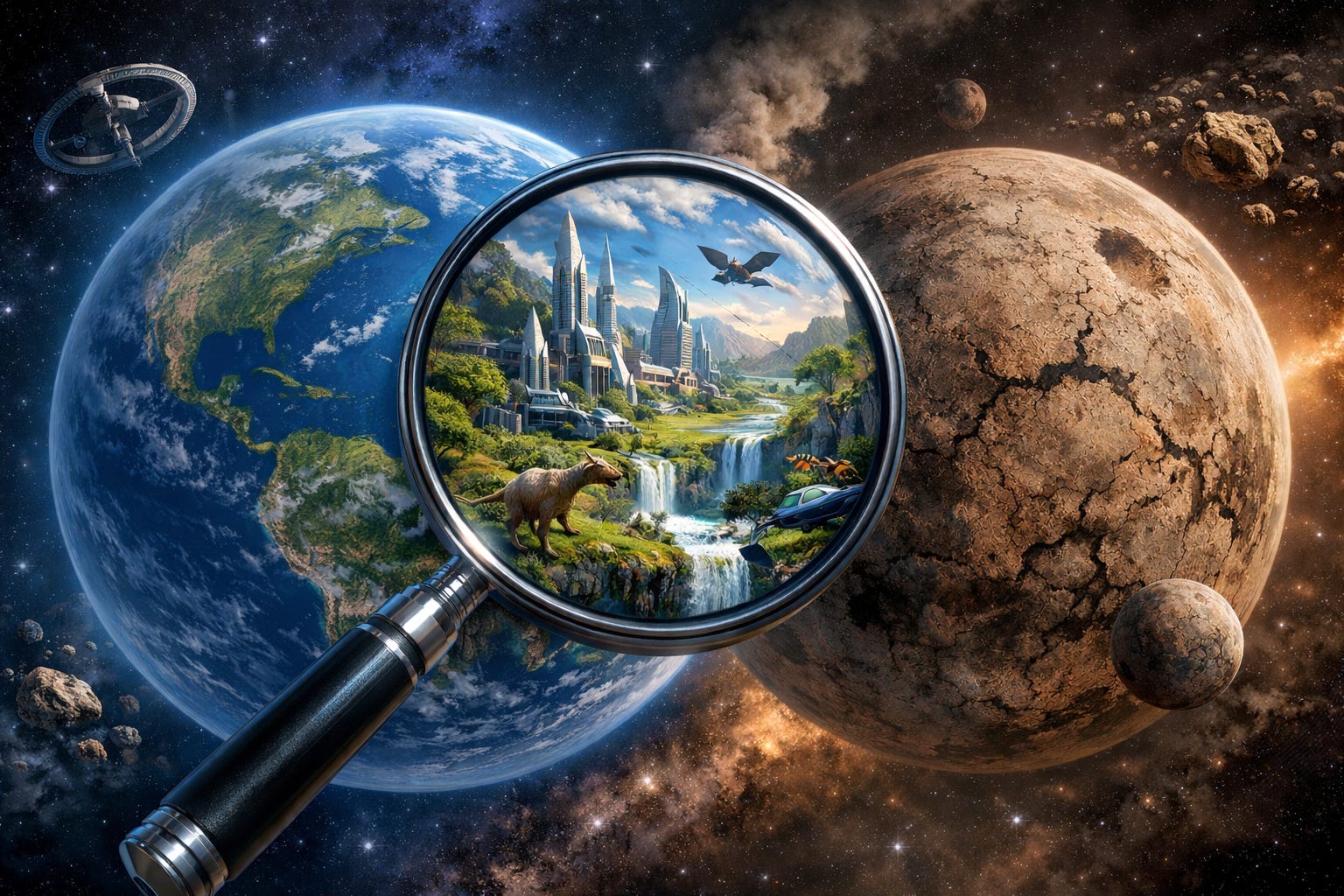
My favorite approach to thinking about intrinsic value is the Distant Planet Thought Experiment. Imagine a planet on the far side of the galaxy, blocked from view by the galactic core, a planet we’ll never see or interact with. What would we hope for on this planet, for its own sake, independent of any potential value for us?
Would you hope that it’s a sterile rock, completely devoid of life? I think not. If you do think a lifeless rock would be best, I have no argument against you. For me this is a starting place, a bedrock judgment, which I expect most readers will share.
Sigh. I for on would favour a planet on which life thrives, where aliens get to enjoy some advanced form of society and technological progress that we can only dream of. But so what? At most that reveals that I have some preference for such a state of affair. Not that I think it’s intrinsically valuable. Yet, this thought experiment is a common method in axiology - the philosophical study of value.
Suppose, then, that you agree a planet with life would be intrinsically better than one without. Would you hope that its life consists entirely of microbes? Or would you hope that it teems with diverse life: reefs and rainforests, beetles and bats, squid and bees and ferns and foxes -- or rather, not to duplicate Earth too closely, their alien analogues, translated into a different key? I think you’ll hope that the planet teems with diverse life.
Would you hope that no life on this planet has humanlike behavioral sophistication -- language, long-term planning, complex social coordination? Would you hope that nothing there could contemplate the meaning of life, the origin of the stars, or its own ancient history? Would you hope that nothing there could create art, or engage in athletic competition, or invent complex games and tricks and jokes? I invite you to join me in thinking otherwise. The planet would be better if it included some beings with that richness of thought and activity.
Would you hope for uniformity of intellectual, aesthetic, and ethical opinion -- that everyone shares the same values and ideas? Or would you hope for diversity? I think you’ll join me in thinking that the world would be better, better for its own sake, if it were diverse rather than uniform. Different entities would have different skills, preferences, passions, and ideas. They’ll fight and disagree (not genocidally, I hope), sometimes value their differences, sometimes dismiss others as completely wrongheaded, sometimes cluster into shared projects, sometimes collaborate across deep disagreement, sometimes be drawn to opposites, sometimes feel kinship with the like-minded, play within and across divides, pursue an enormous variety of projects, explore a vast space of possible forms of life.
That is what I hope for on this distant planet -- not for instrumental reasons (not, for example, because it will maximize happiness), and not merely because it would strike a hypothetical spectator as beautiful and awesome (though it should). Rather, just because it would be valuable for its own sake. An empty void has little or no value; a rich plurality of forms of existence has immense value, no further justification required.
Yeah that’s just entirely question-begging line of argument… Indeed, it’s not clear we need to postulate ‘intrinsic values’ to make sense of such psychological reactions. Think of a Nazi who feels revulsion at the idea of a planet on which there are only non-Aryan people. If you took a Nazi into a philosophy classroom they might say that it would be intrinsically better for this planet not to exist - for all life on it to be annihilated by a comet even. But so what?
Again, at most this kind of thought experiment tells us what a person values. But even the move from your own values, what matters intrisically to you perhaps, in no way justifies the move to declare things intrinsically valuable in themselves. And that’s the kind of intrisic value Schwitzgebel is interested in. Otherwise he couldn’t say that hypothetical oservers should value diversity on a planet we could never learn about. Even if we did a survey of Earth’s population and most would judge a more diverse planet to be better, this does not tell us anything about intrinsic values.
The philosopher David Hume early on recognized that the “mind has a great propensity to spread itself on external objects” - it’s so easy for us to just take the things we value and declare them to reflect the right kind of intrinsic values. And that anyone who doesn’t recognize them should be seen flawed in some way.
While moral nihilism, the denial of any intrinsic values, has an admittedly unsavoury flavour to it, I suspect that the hostily towards nihilism largely stems from people’s recognition that there is nothing to be said to a nihilist that would make them share your particular values that you think should be recognized by everyone as intrinsically valuable. Humanity is a highly conformist and tribal species. Declarations of intrinsic value are often tied to control of others, e.g. the intrinsic value/sanctity of life leading to control over women’s choices. If Schwitzgebel really values diversity, he should become a moral nihilist, which places the least constraints on the diversity of life projects people may chose to value for themselves. That’s an instrumental justification, but it’s better than the thought experiments philosophers have come up with to support the misguided idea of intrinsic values.
For a more in-depth argument for moral nihilism please take a look at the following essay:

Finally, I am entirely open to be convinced of intrinsic values, but I have not seen any good arguments in their favour yet. If you believe in intrinsic values, whether of diversity or anything else for that matter, I’m curious to read your arguments for them in the comments.
If you made it to the end of this post please like, share, and subscribe. It helps a lot to reach a wider audience. I am also interested to read your thoughts in the comments, regardless of whether you agree or disagreee. I try to respond to all.
Once again, Walter, you rightly call out bullshit. Yet another example of how humans are rationalizing, not rational, creatures. "My personal preference must be a Universal Truth!" Or, as you rightly put it, "it’s so easy for us to just take the things we value and declare them to reflect the right kind of intrinsic values."
Bridging the is/ought, one might claim that there are specific examples where diversity is essential to thriving. For instance, under the Red Queen Hypothesis, sexual recombination promotes diverse mixing of genetics as a resilience to the threat of microorganisms. We can also see a range of examples where diversity yields robustness, from the success of stock market portfolios to the basket of inputs in prediction markets. Using a selection-style evolutionary epistemology (a la Bartley channeled through Liane Gabora's honing refinement), the motif continues. I might be able to put together an argument that optimal induction is tied to diversity using an algorithmic information theory model since only variation-selection approaches across diverse models can potentially span the state space of Turing machines in search of minimal ones.
I don't think this is enough to meet the requirement of "intrinsic," though, but it clearly is valuable at many scales and in many contexts.