
What Everyone Gets Wrong About 'New Atheism'
Dawkins, Dennett, and the Death of the Public Intellectual

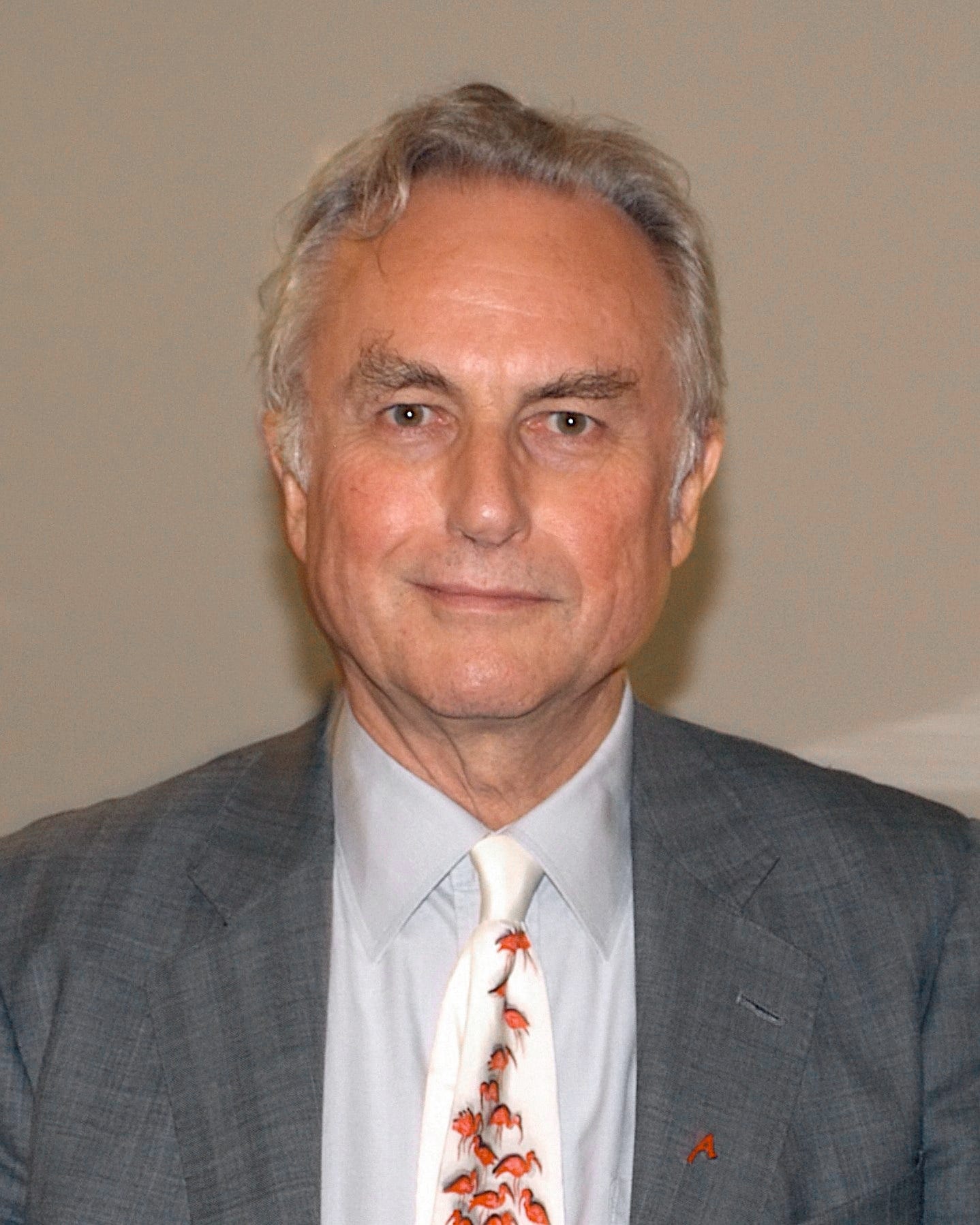
“Mock them, ridicule them in public. Don't fall for the convention that we're all too polite to talk about religion. Religion is not off the table. Religion is not off-limits. Religion makes specific claims about the universe which need to be substantiated, need to be challenged, and if necessary, need to be ridiculed with contempt.”
- Richard Dawkins
Substack has offered me the wonderful opportunity over the last months to write polemical essays against views with which I vehemently disagree and, sometimes, find utterly implausible and unserious, if not downright dangerous. For many of them, I would not want to waste my time writing actual academic articles and thereby giving the impression that I thought they were worthy of such scholarly engagement. They aren’t. And yet, what they do deserve is mockery, ridicule, and hostility — lest we give the impression that silence some sort of acknowledgement.
For modern academic writing has changed. Engagement with a view in a scholarly journal today requires a language of excessive humility, taking seriously, and thus raising the status of any view one may wish to criticize. Journals and even book publishers no longer allow the polemic, mocking style that characterized plenty of earlier scientific and philosophical writing that helped bring the Enlightenment about by sorting the good from the awful. The same applies to modern op-eds, essays, and the like published in public media for the public, which lack the sharp bite of earlier times, falling prey to excessive editorial control.
Unfortunately, the polemical essay has become a bit of a lost form of art. And we’d do well to bring it back. Substack, no doubt, is one of the best places to do so today. For its demise, as I shall argue, played a major role in the gradual decline of the public intellectual.
Take panpsychism for instance. (If you don’t know what it is, just keep reading, it would be a waste of your time to look it up.)
One reason panpsychism has risen in recent years as a view of consciousness, in the eyes of some, a ‘promising’ alternative is simply that most philosophers of mind and consciousness scientists find the view so ludicrous and unworthy of academic discussion that they do not even waste their time writing rebuttals. That refusal should not be confused with the idea that they simply lack counterarguments.

The panpsychist resembles a conspiracy theorist who gleefully interprets others’ disinterest in engaging with their absurd theories as evidence that their ideas cannot be challenged. They present the long list of counterarguments philosophers have raised against materialism, compare it with the very short list raised against panpsychism, and suggest, ‘Well, shouldn’t we embrace panpsychism, then? It does not suffer from these problems’, as if the problems with panpsychism were not so vastly more significant that they make the view appear pseudoscientific and pseudophilosophical to most philosophers, scientists, and, of course, the public.
But I haven’t shied away from attacking views that are much more mainstream than panpsychism. I attacked a priori metaphysics, traditional intuitionist analytic philosophy, and, in my latest essays, moral objectivism/realism — see here:


I was not surprised to receive some very hostile comments. After all, I compared the notions of objective moral facts, rights, duties, and related notions to unicorns, gods, and other fairy tales.
One response, in particular, made me chuckle quite a bit. For a popular Christian substack newsletter compared my attack on moral realism to a worse version of New Atheism:
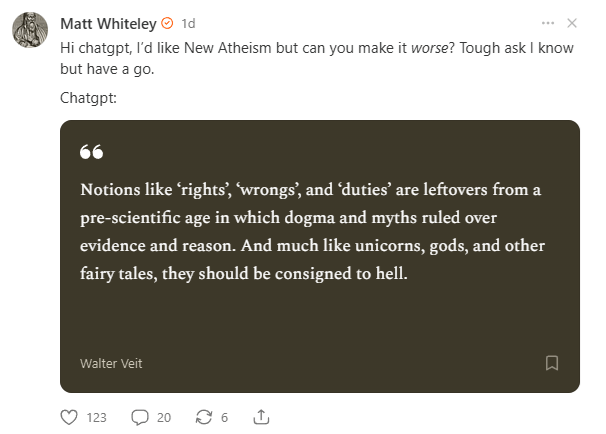
As it happens I agree if you take the moral sting out of the term “worse”. For the very properties Whitely, many other religious folks, and even some atheists like Alex O'Connor identify as bad about New Atheism are ones I find praiseworthy. To be described as a more extreme version of New Atheism, is really something I see as a compliment, for there is no philosopher that has influenced me more than Dan Dennett. More so than receiving a PhD or publishing dozens of journal articles, it was really Dan’s praise that was the highest honour that I could receive.

I am thankful to him that he starred in my very first podcast episode, which was unfortunately only a short while before his death, where I also ask him about New Atheism. Well worth a watch:
When I confronted him with the now common observation that the New Atheism movement seems to have crumbled in the last decade, he said:
Daniel C. Dennett:
“I don’t think [New Atheism] crumbled. I think it’s done its job. It’s awakened the world. The percentage of people who are not going to church is rising—it’s the fastest-growing segment of the population worldwide now.
I say: be patient. We don’t have to beat the drum for this, it’s happening. I think all the pieces are in place. We can now just calmly sit back. Give the cake time to cook, give the cheese time to ripen. Be patient, be gentle, it’s happening.
And be ready to help put out the fires of anguish. A couple of days ago, the Pope fired a bishop in America. Good, that’s a good sign! Congratulate him, thank him, and let’s hope many other things like that happen.
We’ve got a lot of fires that we have to put out. There’s a lot of people who need consoling. There’s a lot of people who should be allowed to be comforted by their delusions until they die, basically harmlessly.
So, I’m all for keeping a very gentle pressure on, not overdoing it—because it’ll backfire.”
While I frequently agree with Dan, I disagree with him here. The waning pressure of New Atheism led to a resurgence of public religion. Sam Harris, Richard Dawkins, and Christopher Hitchens, who were often much more hostile in their criticism of religion received far more attention and I suspect largely due to Dan’s significantly more moderate tone, which religious folks, of course, found only slightly more tolerable. The risk of putting too much pressure on religion is vastly outweighed by that of being too gentle.
So what are these properties of New Atheism that people found so objectionable?
Let’s take Bentham’s Bulldog, another theist substacker, who described the movement as marked by “incuriosity, ignorance, and imperiousness.” That’s a very common view. Indeed, it’s not unique to religious folks. They are also shared by those who are often considered the new generation of internet ‘atheists’, such as Alex O'Connor and Joseph Folley, who consider themselves agnostics (with an admittedly low credence in the existence of God) and have turned against New Atheism:
Joe Folley, for instance, argued:
“[New Atheism] aimed to not just make a case for non-belief, but treated belief as if it was something that only a stupid person can have, and that the correct response for any argument for God was simple mockery.”
But what they all fail to see in their criticisms of New Atheism is that all of these things were the point. New Atheism did not go ‘wrong’ at all.
It’s very point was to mock religion, to ridicule it, to show no interest in it, to be ignorant of minor variations on some alleged proof of God’s existence, and to display what many described as an ‘arrogant attitude’.
But aren’t all these things bad? Don’t they violate the norms of a serious, respectful discussion among equals? Well, yes, of course. Because religious belief is not equal at all.
Standing on a stage with a theist to ‘seriously’ debate the existence of God, or writing a book that offers a ‘serious’ scholarly criticism of religion, is tantamount to wasting one’s time writing a scholarly treatise on why we should not believe in fairy tales, Santa Claus, unicorns, wild conspiracy theories, and other ridiculous notions. “All this straining to prop up beliefs which require so great an expense of intellectual toil and ingenuity to keep them standing,” as J.S. Mill would have said, is colossal waste of intellectual resources — doubly so in responding to it.
To use another quote by J.S. Mill, religious reasoning to defend theism is “a misapplication of noble impulses and speculative capacities, among the most deplorable of those wretched wastes of human faculties which make us wonder that enough is left to keep mankind progressive, at however slow a pace”
Imagine someone criticising a biologist for not seriously engaging with a purveyor of pseudoscience on a platform or stage. Or an economist with a fortune teller. Or a philosopher with a believer in whatever superstition we could imagine. If someone criticised them for being “pathologically incurious, confused, and smug,” most of us would react with nothing more than an eye roll. That is the proper response here.
The common and, at first glance, reasonable point that we should engage in respectful, serious debate presupposes that the positions at stake are equal. This is the pre-theoretical attitude many members of the public have, treating ‘alternative medicine’ and ‘Schulmedizin’ (the German word for medicine taught in universities) as even remotely in the same ballpark. The ignorant demand that their ignorance be honored.
But most views are not even remotely equal. Religious people would surely acknowledge that it would be ridiculous to demand these attitudes in the imagined scenarios above. A society could hardly be rational, reasonable, and truth-seeking if it did so. Some are simply ridiculous. Intellectual decency demands nothing less than that we mock religion and all the other fairy tales, pseudoscientific claims, and conspiracy theories with which humans become infatuated. Anything else would confuse the norms of debating clubs with those of genuine intellectual investigations of reality. It would be the downfall of the Enlightenment itself.
Thus, when I asked Alex Rosenberg, another prominent New Atheist philosopher, why he even bothered debated William Lane Craig, he unabashedly replied:
“I debated Craig for the money and the chance to plug my book. I only wish I had taken a more mocking tone and had a lighter touch.”
People forget that it is only thanks to the New Atheists that religion lost its widespread status as something immune from criticism, which was regarded as impolite. Prior to New Atheism, discussions of religion, whether online or offline, were filled with some of the most ridiculous arguments one could imagine, arguments that people could get away with only because of norms of politeness. Admittedly, the fear of causing offence is still far too strong. But it was precisely because of the polemical style of the New Atheists that humanity took further steps towards rational discussion, and we need more of that mockery rather than less.
Whatever strawmanning and shallow criticisms they may have offered of some specific theologian’s argument, there are millions of religious people who believe in God for precisely those ‘strawman arguments’. New Atheism wasn’t an attack on academic theologians or philosophers of religion, per se, though their fields are, indeed, largely illegitimate “part of our collective attempt to model the structure of objective reality” to borrow a phrase from one of my favourite books. The attack was directed against religion itself, both its social structure and the whole set of beliefs, not just the existence of some supernatural entity.
The re-emergence of theists in the intellectual sphere, not unaided by the culture wars, has been accompanied by the indignant claim that their arguments were never really taken seriously by the New Atheists. They were mocked. The New Atheists were not genuinely curious about their ideas. Dawkins, Hitchens, and Harris were arrogant. And so theists play the world’s smallest violin to elicit pity, harnessing our natural tendency to perceive such behaviour as ‘unfair’ in order to convince people that theism is intellectually valuable after all.
It is not.
This is the exact same playbook used by conspiracy theorists, peddlers of pseudoscience, and purveyors of every other form of nonsense to draw people into their clutches.
For as long as humanity strives to understand reality through serious academic debate between legitimately competing views, intellectuals will have no choice but to continue mocking the ideas that seek to undermine the enlightened pursuit of truth, whether that is pseudoscience or religion. Politeness be damned, lest we return to the Dark Ages.
What was called ‘New Atheism’ simply marked a transition point at which theism lost its status as a serious intellectual position. As Dennett once wrote:
“I had no interest in canvassing arguments for the non-existence of God, or writing about the prospects for atheism – a term which will, I’m sure, eventually become as unnecessary as ‘round-earthism’.”
Critics fail to recognise that New Atheism was the consequence of a shift in how intellectuals viewed religion, not a movement that tried to achieve that shift. This new intellectual attention to religion, in books, lectures, and the like, arose not because religion had suddenly become a serious topic worthy of engagement, but for precisely the opposite reason. Religion had retained an undue influence over our modern world that had to be removed.
And, again, to achieve this, the mockery of religion must continue until far into the future when all humans come to see religion as the ridiculous folly of a pre-Enlightenment era that it is. As Dawkins put it: “I’m all for offending people’s religion. I think it should be offended at every opportunity.”
Many people may hate intellectuals for their arrogance, lack of curiosity in nonsense, mocking tone, and so forth. But these are essential to being an intellectual. The hatred for intellectuals, experts, academics, etc., is as old as expertise itself. Don’t fall for it due to a misperceived sense of injustice. People can overshoot, of course, in their expression of these attitudes. There are plenty of cases like that. Perhaps the New Atheists did overshoot many a times. But that’s inevitable. It’s not a proof that their approach was wrong.
As an analogy, there is no perfect judiciary where every criminal gets persecuted and every innocent person goes free. Many people naively think that we should never have innocent people behind bars. Unfortunately, we don’t have perfect knowledge. A world in which no innocent person lands in jail is one in which there are no jails at all.
Likewise, a world in which intellectuals treat all views with respect and kindness is a wretched world where there are no longer any intellectuals at all. A world in which the obscurantist would thrive.
If you made it to the end, please like, share, and subscribe. It helps a lot to reach a wider audience and create discussions, even if you strongly disagree. Please also let me know your thoughts in the comments, regardless of whether you agree or disagree, I’m keen to read the feedback of my readers. I try to respond to all.
I will agree with you there is plenty about Dennett worth admiring, I think of the four he was the most intellectually curious, his admiration of William James made his view of religion more open to pragmatism, and 'Breaking the Spell' is one of the most open minded of the New Atheist outputs of the time, in it he's less interested in dunking and more in trying to explain his view. Obviously I don't agree with plenty or likely most of his views, but both on religion and consciousness he can be maligned in a way that misses the mark.
Such a hilarious post . And you have the courage to call yourself an intellectual..🤣🤣