Why Consciousness Science Needs Darwin
A Darwinian Revolution for Consciousness

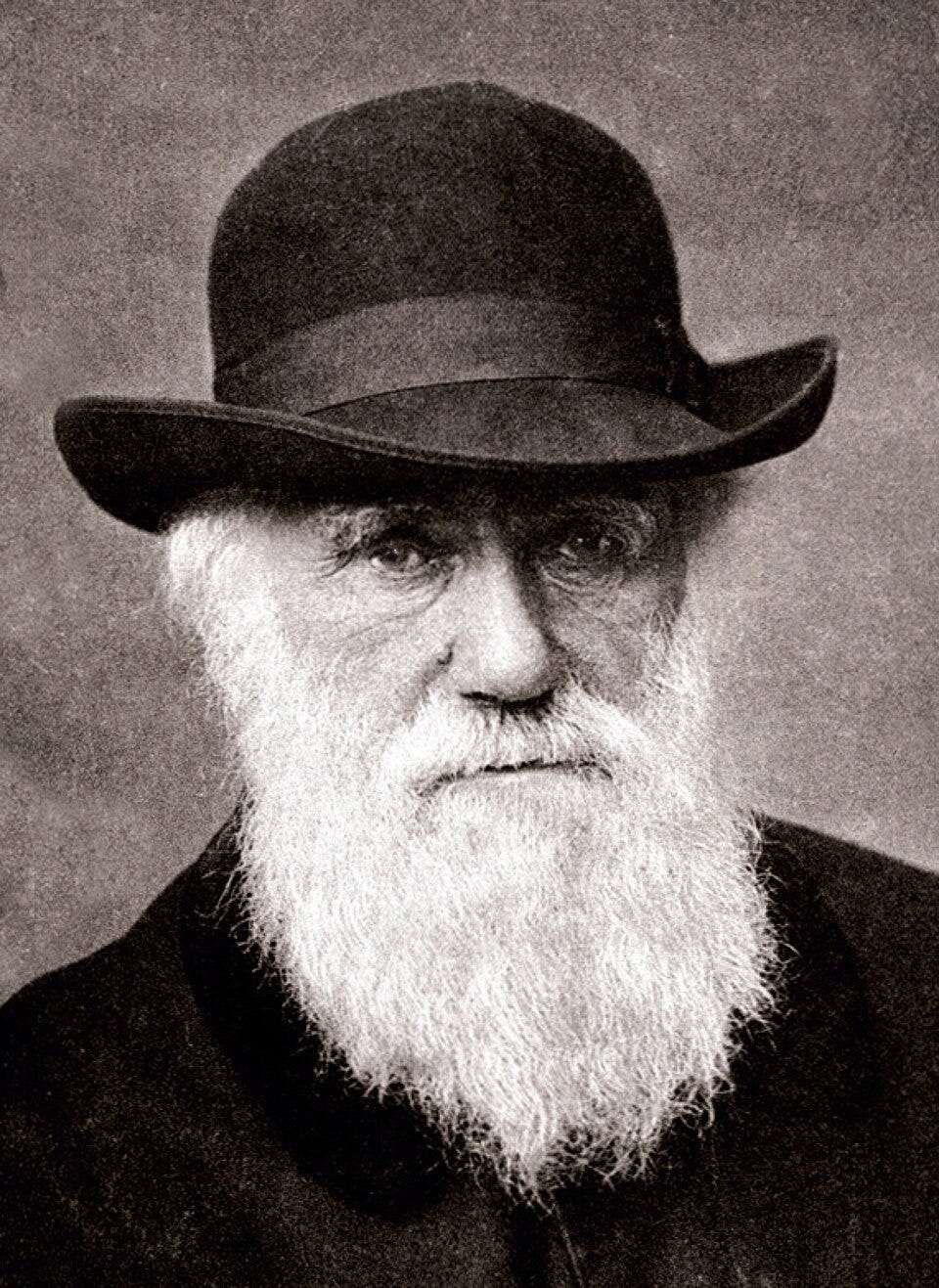
Why does consciousness exist? The answer lies in the evolutionary origins of the simplest forms of subjective experience, not in studies of human consciousness alone, which represent just one special case within the animal kingdom. The need for a Darwinian bottom-up approach that reconstructs these simple origins and then successively builds more complex forms on top was a central message of my book A Philosophy for the Science of Animal Consciousness.
This may not seem controversial, but philosophers have long been hostile to the idea that evolutionary biology could resolve major philosophical problems. I therefore anticipated immediate pushback. But it did not come.
In the first ten commentaries published in special issues on my book, scientists and philosophers alike agreed with my evolutionary approach, applying my theory to species such as elephants and macaques (more on this in a future post). I was almost disappointed, however, having prepared myself to defend the importance of evolution for understanding the mind.
Then Christian de Weerd’s commentary arrived just before the submission deadline. I had invited him because of an earlier argument he published with Leonard Dung against Darwinian approaches to consciousness. No objection could be more fundamental, of course, so I was glad to have the opportunity to respond in depth in a 15,000-word reply addressing several critics.
My journal article, titled “On the Evolution, Science, and Metaphysics of Consciousness”, was published open access this week. Here, I will summarize my arguments for a general non-specialist readership.
How We Study Consciousness Now
Walk into consciousness labs and you will mostly find studies on humans relying on verbal reports. This evidence is then used to construct theories of consciousness and applied to special cases like chimps, octopuses, shrimps, maybe AIs.
De Weerd admits we have expanded our toolkit to include other studies in other animals such as great apes, but this is far from treating consciousness in a Darwinian manner. He argues we can capture markers of conscious processing in our species and then apply these tests to other animals. But consciousness may come in radically different forms in distantly related species. While I don’t deny that this approach can make progress, it remains fundamentally tied to humans. An evolutionary “bottom-up” approach shifts the focus from a “top-down” approach centred on humans to the rest of the animal kingdom.
However, de Weerd denies that this is even possible, because he thinks that an evolutionary bottom-up approach means ignoring human evidence entirely. But that is a strawman.
How We Should Study Consciousness
If we look beyond consciousness this demand should seem obviously ludicrous. No evolutionary biologist studying, for instance, the immune system or the eye, refuses human data. Evidence from Homo sapiens sits alongside evidence from other species. That is how evolutionary biology works.
Unfortunately, consciousness science has remained fundamentally a-historical. When researchers sometimes consider its origins, they ask how and when human features of consciousness could have evolved. Imagine studying vision this way: obsess over human retinas, build elaborate models of our colour vision, then work backwards to other animals. You would miss the compound eyes of shrimp, the pinhole eyes of nautiluses, among many other strange inventions. Biology is about diversity of forms, not about a single scale towards human perfection.
Is consciousness fundamentally different from every other biological phenomenon, or have we been treating it that way for no good reason? Biology was revolutionized by Darwinian tools. Natural selection. Functional analysis. Phylogenetic thinking. These cracked open the mysteries of eyes, immune systems, flight. Strip these tools away away and you are back in pre-Darwinian biology, which is precisely where consciousness science finds itself.
De Weerd claims my evolutionary approach lacks tools to disentangle conscious from unconscious processing without controversial assumptions. But he is mistaken. The bottom-up approach uses everything the top-down approach in addition to the tools of evolutionary biology. Facts about the origins of animals, the brain, and ancestral lifestyles provide constrains and provides evidence to evaluate which theories make sense.
Theories built around uniquely human capacities (such as complex language, meta-cognition, self-awareness) mistake what makes us distinctive for what makes consciousness possible. This is why I proposed the pathological complexity thesis: Consciousness evolved to help organisms with complex bodies navigate difficult trade-offs. The origins of consciousness were simple evaluative feelings, good and bad, signalling what to do.
De Weerd also objects that evolutionary reasoning is too speculative. But this worry just highlights how consciousness science has put itself in a straight jacket. The top-down approach has insulated consciousness research from the very tools that revolutionized our understanding of all other biological phenomena. Admittedly, that was not entirely unreasonable, at least initially. Consciousness research long struggled for legitimacy. To make it appear as objective as possible they minimized all speculation. But not all speculation is unscientific. All scientific work on the deep past has to deal with sparse evidence. But you simply build competing models, gather evidence, refine theories. This is empirically grounded and entirely justified ‘speculation’.
What is unjustified speculation, however, is the assumption that consciousness should be treated differently than all other biological phenomena.
I am advocating a Darwinian revolution, not because mainstream approaches must fail at understanding human consciousness, but because they will distort our picture of consciousness as a natural phenomenon spanning millions of species across millions of years. To understand octopus minds, crow minds, shrimp minds, and the first conscious creatures, we need to treat consciousness as an evolvled biological adaptation solving specific ecological problems for different kinds of species.
Next time: In my next post, I’ll summarize my responses to my critics on how we should understand the nature of consciousness itself – that is, what is it?
If you enjoyed reading this post please like, share, and subscribe. It helps a lot to reach a wider audience. Thanks! Whether you liked it or not, I am interested to hear your thoughts in the comments.
References
Veit, W. (2026). On the Evolution, Science, and Metaphysics of Consciousness. Adaptive Behavior. https://doi.org/10.1177/10597123251413204
Hi Walter,
Thank you for your thoughts on this matter. You are right on point about the fact that consciousness is the outcome of a Darwinian process. And without understanding how nervous systems and brains evolve one is handicapped to understand the nature of mind.
You state that “Evidence from Homo sapiens sits alongside evidence from other species.” I agree entirely. However, I think that sometimes theorists get trapped into thinking that the approach to studying any phenomenon is “top down” or “bottom up”. But that stance buys into a scala naturae viewpoint that accepts the false idea that evolution is about a linear progression towards humans. So, I say that we try to open this conversation up by avoiding linear concepts like these.
Another way that we tend to get trapped by false notions is by deconstructing species and evolutionary processes into discrete units instead of the continuous variable that it actually is. This is when we make the fundamental mistake of thinking that every species has arisen de novo and has a qualitatively different experience of life than every other. So now we are faced with “human consciousness” and “giraffe consciousness” and “fish consciousness” ad absurdum. This is a non-starter position.
It goes without saying that every species is a variation on a theme. And members of that species are going to perceive and act in the world as a product of their particular adaptive history. But this does not mean there is discontinuity across species in mind. Studies of brain evolution and anatomy tell us that there is, in fact, tremendous continuity and conservatism in the evolution of psychology. For example, there are highly conserved systems in the brains of all vertebrates that – given all the evidence - do pretty much the same thing whether one is a sperm whale or an aardvark. How could it be otherwise? It would be preposterous to think that the same structures do something completely different in each and every species. This does not mean that being a sperm whale is like being an aardvark. But it does require nuanced thinking about how evolution actually works. And it requires that we hold in mind the fact that humans and other species are alike and different - all at the same time.
Thanks so much for this important discussion. All best, Lori
unclear whether you think “meta-cognition, self-awareness” are uniquely human or whether instead it’s “complex…meta-cognition, self-awareness” that you’re claiming are uniquely human. The former is difficult to believe. The latter is difficult to assess.