
The Atheist's Guide to Reality
enjoying life without illusions

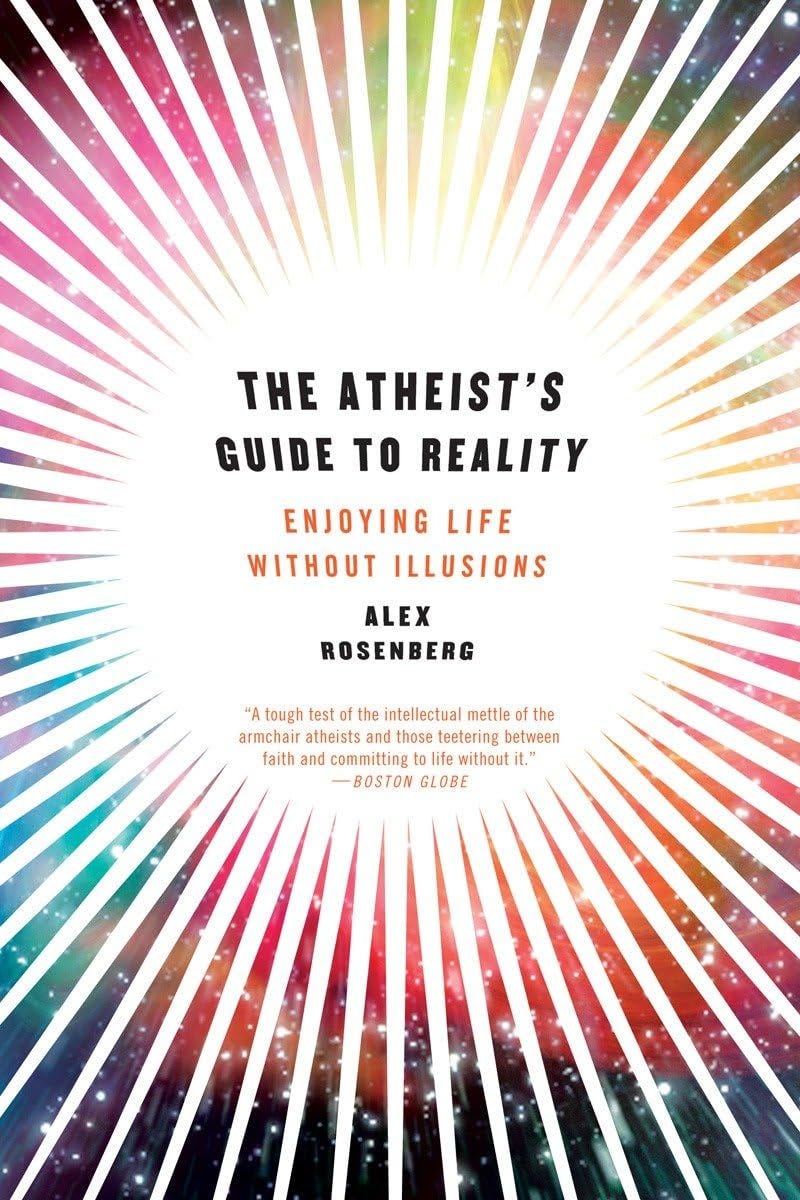
I must have read Alex Rosenberg’s “Atheist’s Guide” around 2014/2015 when I began my undergraduate studies. However, what led me to the book wasn’t that it was a book about atheism, but about the philosophy that makes many of us atheists: naturalism.
The book isn’t really a book defending atheism, indeed, as far as I remember Rosenberg was orginally thinking of re-using the title of Epicurus’ Great work “On Nature” — but with trade books publishers are interested in sales, and so his editors pushed for a title that would draw on the cultural Zeitgeist of New Atheism.
The book sets out to answer some of the most persistant philosophical questions that most of us have wondered about, if we actually take science seriously, in order to live a life without illusions. Now that doesn’t mean there is uniform agreement among naturalists. After all, science is continuesly changing and updating. Naturalists, unlike most other philosophers, are no slaves to their intuitions.
Early on in the book Rosenberg gives a quippy short list of these questions and the answers he is going to defend. Here, I’ll briefly quote them and offer some insight into where I agree with the so-called ‘mad dog naturalist’ himself.
Is there a God? No.
Agreed. Here, we have uniform agreement among naturalists: there is no need to invoke God in one’s metaphysics. Purely speculative metaphysics and natural theology are not even serious epistemological rivals.
Ask someone, who is trying to provide a proof for a god, about their epistemology, and one is quickly disabused of the notion that any serious attempt to understand reality is taking place.
That is not to say that the people are fools or that the arguments can’t be intellectually impressive. But their arguments are — like much of what goes on in (a priori) philosophy — largely pointless “chmess”, as Dennett called it. (An attempt to work out the higher truths about an arbitrary set of alterations to the rules of chess.) Here is a lovely quote to illustrate the idea:
Dan Dennett: “Of course some people are quite content to find a congenial group of smart people with whom to share ‘‘the fun of discovery, the pleasures of cooperation, and the satisfaction of reaching agreement,’’ as John Austin once put it (see Austin 1961, p. 175), without worrying about whether the joint task is worth doing. And if enough people do it, it eventually becomes a phenomenon in its own right, worth studying. As Burton Dreben used to say to the graduate students at Harvard, ‘‘Philosophy is garbage, but the history of garbage is scholarship.’’ Some garbage is more important than other garbage, however, and it’s hard to decide which of it is worthy of scholarship.”
What is the nature of reality? What physics says it is.
Rosenberg is a bit reductive here and I wouldn’t go as far as him. If rephrased as “What is the universal nature of reality?” one can reply with universal physics (see also Ladyman and Ross), but the special sciences, such as economics or biology, are also describing real though local patterns of reality.
What is the purpose of the universe? There is none.
An absurd question really that projects our evolved human capacity to engage in instrumental reasoning unto the world.
What is the meaning of life? Ditto.
There are Darwinian ‘purposes’ in biology, such as the heart having the evolved function to pump blood, or biological systems having the ‘purpose’ to maximize fitness, but that’s not what the question is getting at here, of course. There is no hidden secret.
Why am I here? Just dumb luck.
Indeed.
Does prayer work? Of course not.
Sorry to dissappoint.
Is there a soul? Is it immortal? Are you kidding?
Ditto.
Is there free will? Not a chance!
Now I’d disagree with Rosenberg here and assert the existence of free will, but that’s not the libertarian free will most defenders of it have in mind really. There is a difference in how ‘free’ your actions are as a child versus an adult.
What happens when we die? Everything pretty much goes on as before, except us.
Agreed.
What is the difference between right and wrong, good and bad? There is nomoral difference between them.
Agreed.
Why should I be moral? Because it makes you feel better than being immoral.
People fear nihilism because people would just act selfishly. But we evolved to be nice. If you feel empathy with other animals, it will make you feel good to donate. You don’t need to try to justify that you have an obligation to do so first. Try donating 5 bucks and see how it feels.
Is abortion, euthanasia, suicide, paying taxes, foreign aid, or anything else you don’t like forbidden, permissible, or sometimes obligatory? Anything goes.
This could be misread as Rosenberg thinking everything is permissible — which would be a moral view. Rather he’s denying that there are facts that could make a sentence like “Stealing is bread is permissible when you’re hungry!” true or false. It’s like the question: “Is the king of Germany bald?” — well there is no king of Germany
What is love, and how can I find it? Love is the solution to a strategic interaction problem. Don’t look for it; it will find you when you need it.
Or rather look at the cognitive science literature on what causes people to fall in love. The causes are manifold.
Does history have any meaning or purpose? It’s full of sound and fury, but signifies nothing.
I think this is overstated. What Rosenberg has in mind is that we often tell a narrative history, attributing mental states to people of the past to tell some grand story. To him these stories are closer to the telling of myths in what they can teach us. He is not opposed to empirical research into history. But he denies the idea of “eternal recurrence” — that historical events are doomed to repeat.
Does the human past have any lessons for our future? Fewer and fewer, if it ever had any to begin with.
I partially agree. The more complex human societies become the less predictable they are. And so looking at our past to predict our future become less and less reliable. The rise of AI emphasizes that nicely.
In any case, Rosenberg’s book is well worth a read, since it was written for the public, not just other philosophers.
*
If you have any questions or want to know more about why I believe these things, leave a comment. I’d be happy to offer some more detail there. If you’re interested in a discussion between me and Alex Rosenerg, you can watch the following video:
If you made it to the end, please consider to like, share, and subscribe. It helps a lot to reach a wider audience and create discussions, even if you strongly disagree. Please also let me know your thoughts in the comments, regardless of where you agree or disagree, I’m keen to read the feedback of my readers. I try to respond to all.
I like this very much. I'm a Sapolsky-level determinist, so we disagree there, but I appreciate this post overall.
Thanks for the summary. This book might slot neatly in my bookshelf between Alain de Botton’s “Religion for Atheists” and Sabine Hossenfelder’s “Existential Physics”. Both of which I recommend for style, structure and humour, as well as intellectual substance/argumentation.